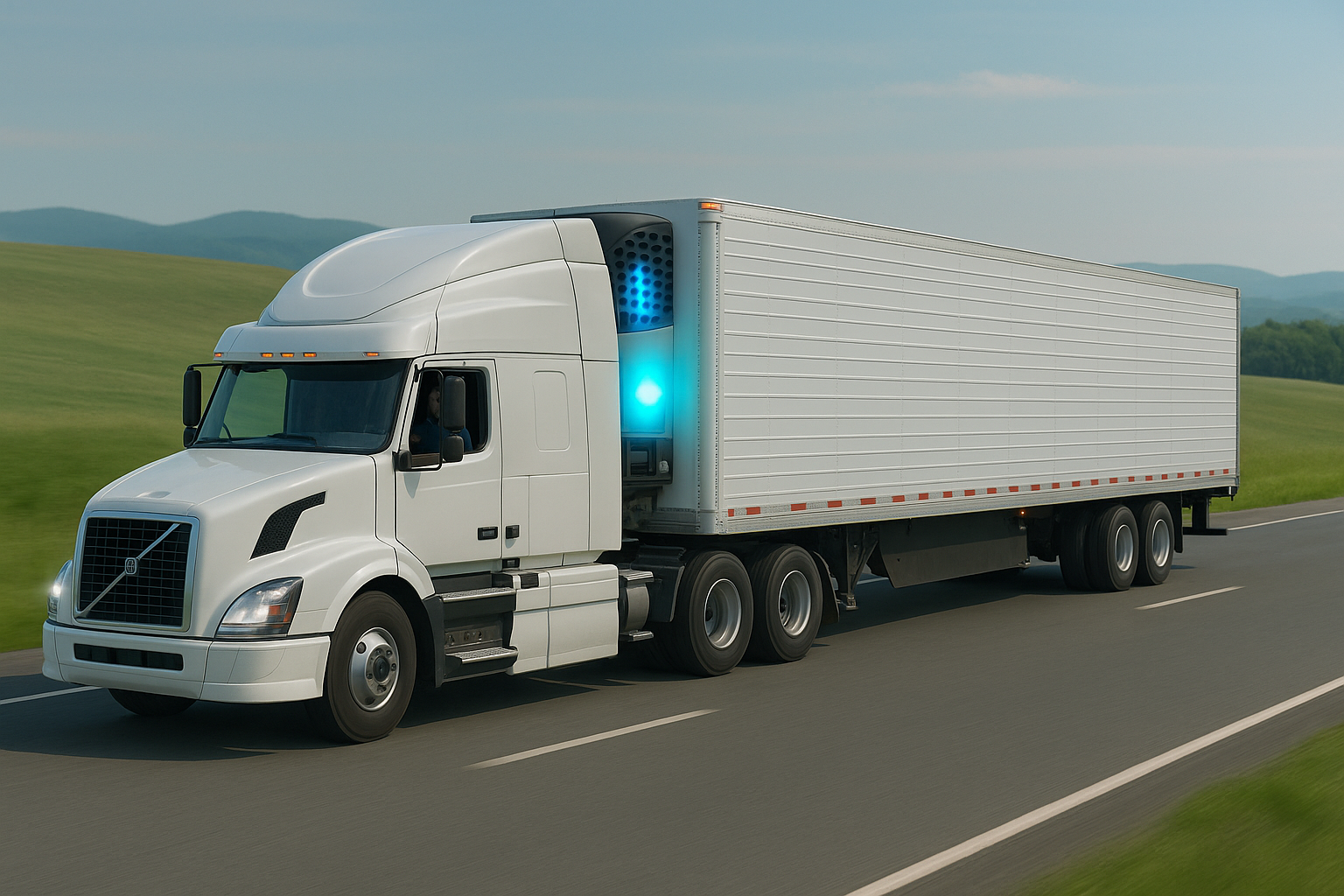
When discussing the payment structure in the trucking sector, CDL-A drivers quickly shift to talking about trucking specializations. Of course, this is understandable: the freight economy is an infrequently fair distributor to the various divisions. Some lanes visibly become more accessible, closer. Some edges up, and some divisions score a goal due to the increase of cargo demand or the decrease in the number of qualified drivers. The pivotal query that every driver inevitably arrives at is precisely: which specialization gets to pay out the most in a shorter time and what is the reason the gap appears in such a way on yearly basis?
Within the various pay grades of a company driver and owner-operator pay, three categories stand out much more often than any others: reefer, flatbed, and hazmat. Each of them has its unique cost structure, skill requirements, workload, health and safety factors, career prospects, etc. But while all these three are trucking sub-sectors that tend to offer high paying trucking jobs, the rate of pay rising is very much dissimilar. It is often that drivers undergo this realization long before they manage to express it into words. Other times, they perceive the disparities through the boom and bust cycles in freight; sometimes in the weekly settlements; sometimes by the reaction of the dispatch in bad weeks. When drivers wrap their minds around the reasons behind the variations, they can make better decisions concerning their careers.
The main thing is, the pay in trucking does not follow a uniform path. The truck driver wages do not depend on the public’s wishes but follow the freight sector. Furthermore, the specialized drivers salary is not free from seasonal, back orders, and industry regulation factors. Market conditions determine the opportunity for drivers, who have to deal with the challenges of moving freight that no one else can. So it is the case with reefer, flatbed and hazmat driver’s wages which go separate ways being affected by the shipping market’s demand, the risk of the driver’s own health, and the importance of time-industrial freight. Specifically, it is yet another reason why the relation between reefer, flatbed, and hazmat compensation is somewhat different. On the flip side of the coin, some drivers learn that medical and regulatory pressure is not a prime mover; rather, they are the ones who dictate the terms as only the licensed drivers can drive and operate vehicles.
Core Characteristics of Reefer vs Flatbed vs Hazmat
| Specialization | Primary Pay Drivers | Workload Type | Sensitivity to Market Cycles |
| Reefer | Appointment-based freight, temperature integrity, consumer demand | Moderate, time-sensitive | Low volatility — consistent year-round |
| Flatbed | Skilled securement, industrial freight, driver scarcity | High physical workload | Highly cyclical — spikes in strong construction markets |
| Hazmat | Liability, risk, insurance, credential scarcity | Compliance-heavy | Stable premium due to regulatory pressure |
The data on the spot market clearly substantiates the discrepancy among various kinds of trailers. The ongoing spot-market information indicates that the reefer and flatbed freight earns more than dry van, with normal averages of $2.44 for refrigerated freight and $2.58 for flatbed transport per mile, as against about $2.07 for dry van. https://trucking42.com/blog/what-loads-pay-the-most-for-owner-operators?utm_source=chatgpt.com
Reefer — Stability and Long-Term Growth
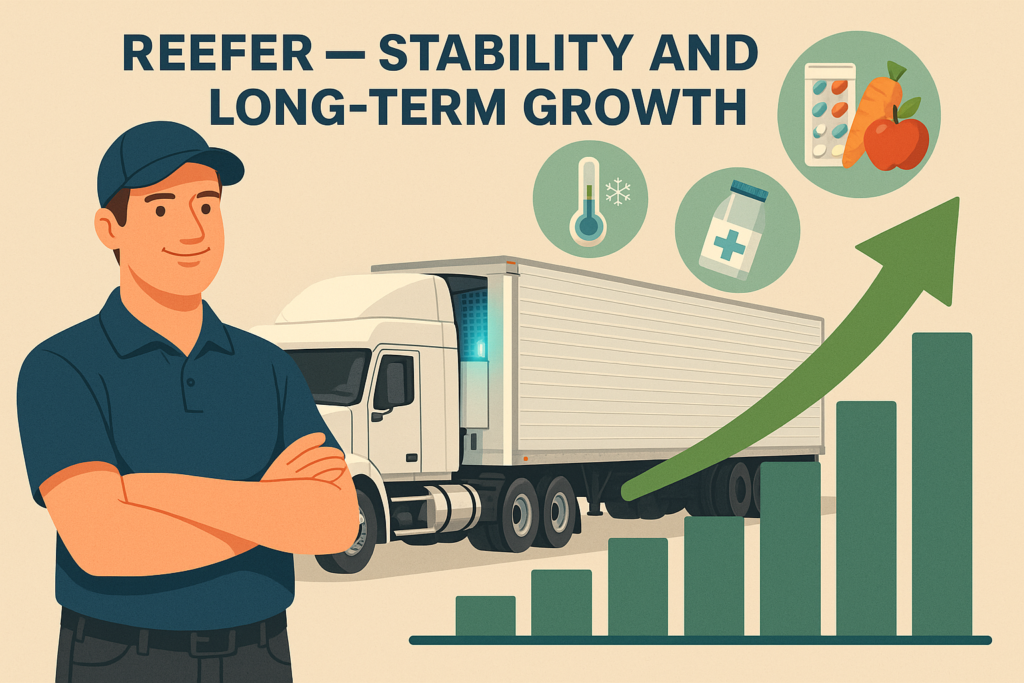
Reefer, also known as refrigerated freight, is the most controversial specialty there is. Some drivers love it while others run away from it. What drivers probably don’t expect is that the pay will grow steadily in the long term. Cool freight almost only depends on what the consumers buy: the products in the grocery store, the medicines and medical devices, and items that need a certain temperature. These classes overcome downturns much more efficiently than dry van freight, therefore, reefer pay is going up even in the off-seasons gradually. The thing that pushes reefer up is not only the volume of the shipment but also the logistics involved: appointments for delivery, night loading, long dock times, and the responsibility for freight integrity. In real life, it is often the case that reefer drivers drive fewer miles but what they get compensated for is a higher rate per mile because companies have to compete with each other to find drivers who are willing to follow these strict policies and come up with possible delays. In terms of increased salary over time, reefer remains one of the most stable niches.
Flatbed — High Peaks and Skill-Premium Pay
Flatbed transport is very different. This specialization, on the other hand, is directly dependent on the construction and industrial markets. When dynamic of those economies changes, flatbed pays a huge mark-up due to the scarcity of skilled drivers who are able to secure loads accurately, deal with oversized freight, work tarping safely, and fulfill all specialized skill requirements. Flatbed, in reality, is an area precisely where the driver shortage issue is not just theoretical. Believe it or not, there are cases when even the most experienced CDL-A drivers will refrain from taking a flatbed course because of the physical difficulties and exposure to the elements. This lack of drivers makes flatbed one of the quickest expanding fields in terms of pay when the construction and manufacturing cycles get underway. However, the increase in salaries never comes across as a steady process; it jumps up, stays the same for a while, and then spikes again. Contrary to reefer, the flatbed driver pays are not simply raised because the freight has to be moved; they go up when the companies bid aggressively due to shortage. During market peaks, flatbed often registers some of the highest paying trucking salaries.
Hazmat — Consistent Premium Driven by Risk
The transport of dangerous goods, or hazardous materials transport, comes entirely different. It does not depend on grocery business or construction but rather on laws, liability, the insurance market, and risk factors. As a result, the pattern is unique: hazmat pay increases relative to both reefer and flatbed pay when the regulatory pressure fluctuates or when companies seek drivers to operate tanks with the needed training and endorsement. Hazmat includes factors that require the driver not only to account for freight but also to protect the public, environment, and ensure strict DOT compliance. Often the pay for hazmat increases in ways not directly tied to the regulatory burden; the simple shortage of drivers maintaining their tanker endorsement and hazmat credentials makes the companies raise their compensation. Hazmat remains one of the most consistently premium-paying segments in trucking.
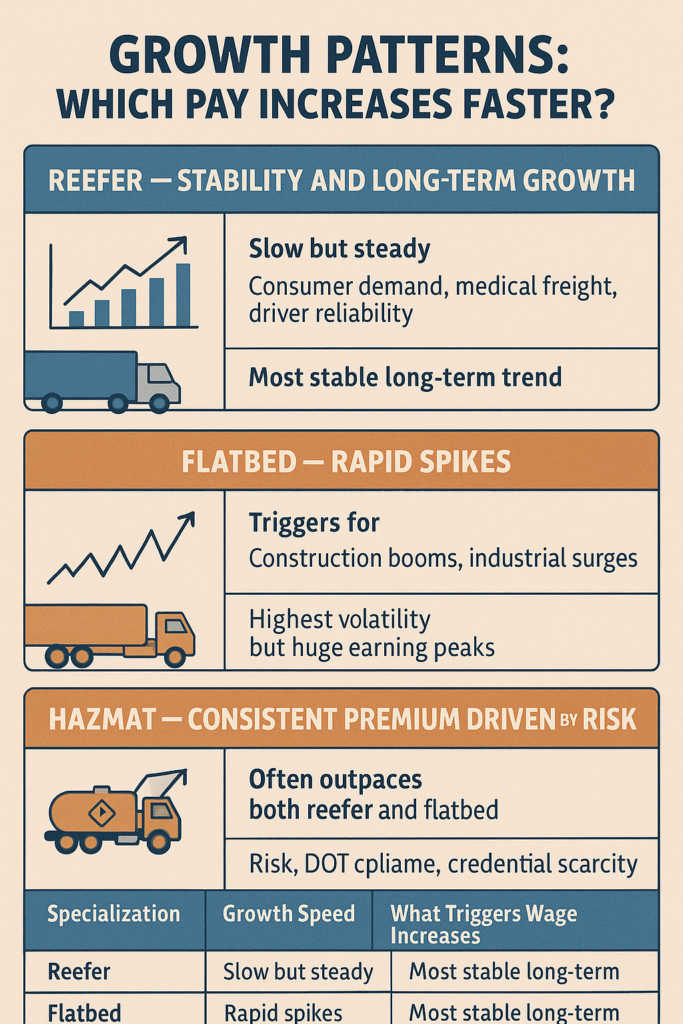
Growth Patterns: Which Pay Increases Faster?
| Specialization | Growth Speed | What Triggers Wage Increases | Notes |
| Reefer | Slow but steady | Consumer demand, medical freight, driver reliability | Most stable long-term trend |
| Flatbed | Rapid spikes | Construction booms, industrial surges | Highest volatility but huge earning peaks |
| Hazmat | Consistent premium | Risk, compliance, credential scarcity | Often outpaces both reefer and flatbed |
Highest Paying Trucking Jobs In The Industry!
Company Drivers vs Owner-Operators — Why the Gap Widens
For company drivers, the differences are manifested in the weekly paychecks. For owner-operator pay, the differences appear in the net fuel efficiency, accessorials, negotiation capacity, and the gap between contract rates and operating costs. An owner-operator working in the reefer segment experiences different peaks and valleys than someone hauling hazmat. High shipping price doesn’t guarantee consistency though, because risk is nonlinear.
What Type of Driver Each Specialization Attracts
Reefer attracts drivers who prefer:
- Stability
- Predictable freight
- Fewer freight disruptions
Flatbed attracts drivers who want:
- Physical challenge
- High pay spikes
- Hands-on load securement
Hazmat attracts drivers who value:
- Premium wages
- Compliance and professionalism
- Low competition due to qualifications
Final Pattern — Stability vs Opportunity vs Premium
Reefer is stability.
Flatbed is opportunity.
Hazmat is premium.
What Pays More In Trucking? ” FLATBED | TANKER | REEFER “
Thus, what does “faster growing pay” mean in practical terms? For drivers who are contemplating what direction to take in their trucking careers, the term does not refer to the highest weekly paycheck. It refers to the specialization whose increased salary trend climbs steadily over months and years rather than fluctuates chaotically. And this is where the disparity among reefer, flatbed, and hazmat becomes most visible, especially when comparing how trucking specializations react to market pressure and how trucking industry pay shifts across different freight segments.
Reefer develops due to demand that is never fully absent. Flatbed spikes explosively when the industrial freight surges. Hazmat grows because risk never becomes cheaper. Drivers who are attuned to these shifts turn the freight economy into their advantage.
Owner-operators are particularly affected by these changing cycles. Reefer owner-operators benefit when rates stay stable during downturns. Flatbed owner-operators earn significantly more during construction booms. Hazmat owner-operators often outperform both due to risk premiums added by shippers and carriers. The owner-operator pay gap between divisions can be massive depending on timing and freight cycles, demonstrating once more how Trucking specializations shape overall trucking industry pay trends throughout the year.
FAQ
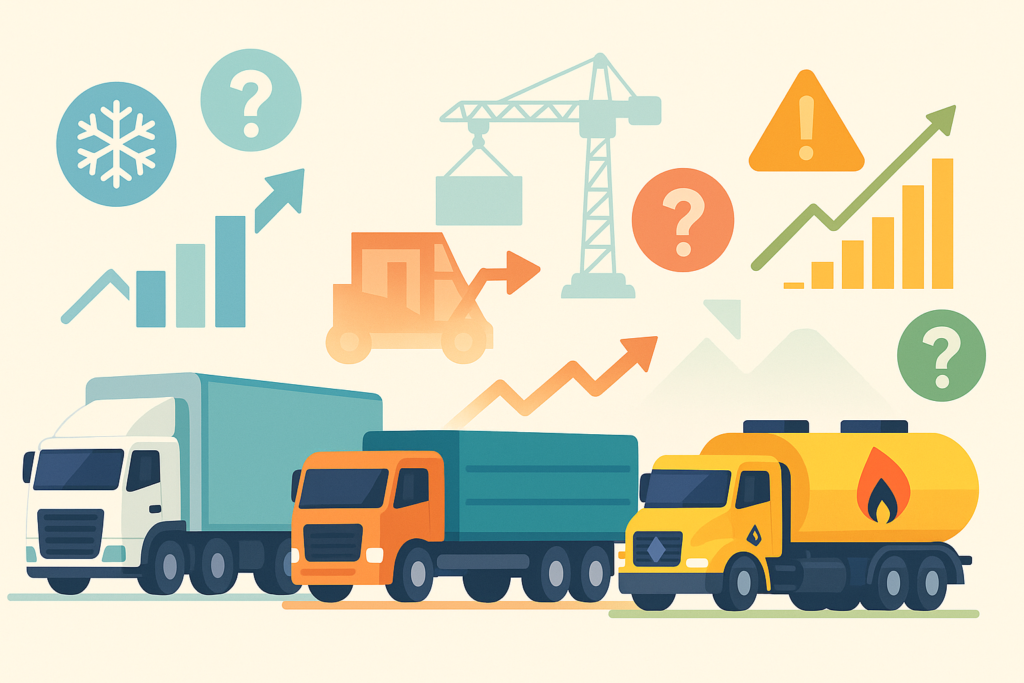
1. Why are specializations in the trucking industry increasing the pay at different rates?
Every segment has its own micro-economy that operates independently. For example, refrigerated freight is subject to consumer demand, flatbed transport relies on the cycles of the construction industry, and hazmat pay is influenced by regulatory pressure as well as insurance requirements. A result of this, the payment in the trucking industry is not uniform – it changes according to the overall state of the freight economy.
2. Is it true that CDL-A driver salary actually increases when changing from a dry van to another specialization?
Most of the time, yes. The truckers, who move to other, more complicated specialties, enter with the skills that fewer people have. Due to the need for competent personnel, companies are ready to pay more for the employees. That’s why, in the case of reefer, flatbed, and hazmat, the driver salaries usually rise more abruptly than in general freight.
3. What is the cause of flatbed transport experiencing considerable pay jumps rather than consistent increases?
Flatbed income rises or falls with the performance of the industry and construction sectors. When the sectors are in high demand, the drivers become few and far between, thus lifting the wages sharply. These variations are characteristic since not many drivers take on the burdensome and responsible work that comes with this kind of transport.
4. Is it possible for hazmat to really surpass reefer and flatbed in the long term regarding the income?
In many locations – the answer is affirmative. Hazmat’s earnings rely on risk, compliance, and liability factors – other than the actual freight volume. Since the very small number of drivers are able to secure a hazmat and tanker endorsement, companies offer higher pay to recruit, train, and maintain qualified drivers. As a result, it is often one of the main options in the industry with the best earnings over the years.
5. Would the choice of specialization also help to prevent the income from being affected during the downturn in the market economy?
Most frequently it does. A reefer can depend on a stable consumer demand. Flatbeds can be down in a slow construction period but can surge up after the economy is regained. Hazmat remains robust due to the regulatory requirements and industrial needs. In a changing freight economy, the selection of specialization can serve as a barrier – or a propeller.
6. What is the most effective way of projecting future earnings before changing over to another segment?
Drivers gain a better insight by utilizing a variety of factors for comparisons such as a record of past settlements from the current drivers, a realistic number of weekly loads, overview of seasonal variations, and skill requirements from each specific segment. It is this way that a much more reliable forecast of the CDL-A driver pay is made than giving a single example of a “good week” from a recruiter.
7. Is there a specialization that will always bring in the most money?
No, it – the champion – changes with the market cycles. In case of hazmat, it affects the stable markets the most; flatbed transport develops very quickly when construction is booming, and reefer is the most reliable earner when freight operations are erratic. The curve of the “best-paying” road always depends on the situation, the market, and the driver who is ready to accept certain obligations.
Leave a Reply