
The trucking industry is a nexus of constant stress and opportunity. On one hand, there is an increasing freight demand, the requirements of drivers are changing, and carriers are in a tough competition with driver turnover. Drivers continue to raise their wage, offer sign-on bonuses, and experiment with the new retention initiatives, however, the same queries come back to trouble the industry every year: What bonus programs truly help drivers to stay either through tangible benefits, or do they make for a good impression, and are they just national headlines?
Driver retention is not just a question of available resources like “more money.” It is instead a multi-dimensional equation made of social psychology, operational efficiency, and good relations, that is, it is the sum of the elements making the driver feel respected, supported, and equitably compensated. It is not only the drivers leaving one company in favor of another that are making the “monthly pay” topic a big issue; but it is the “compensation package=” being seen as unpredictable, not fair, or disconnected from the realities of the road that causes the drivers to walk away. Bonus systems are what can shorten that gap—if the bonuses are easy to get, durable, and in line with the drivers’ priorities.
This article provides useful insights into the types of bonuses which actually steers drivers’ commitment, boosts driver satisfaction, lowers driver turnover, and indirectly enforces retention within a competitive transportation market.
The Importance of Bonus Systems in Driver Retention
The development of driver retention measures usually pivots on edging up mileage pay or ensuring more home time, which are obviously targeting miles and kilometers drivers. Nevertheless, a general perception has been formed that base pay alone should not be regarded as the exclusive variable to stabilizing staff retention even in the long run. Consistent performance, such as managing to keep safe, on time deliveries, and employee loyalty should be rewarded top performers first. It is a typical culture for drivers to mix their work autonomy with external recognition.
Bonus payments are the commodities which will help to attain the set drivers’ targets which are acknowledged by the carrier.
The trucking industry has seen unique challenges such as cyclical freight, inclement weather, mechanical breakdowns, and job pressures. Good bonus systems are realistic in terms of transportation dynamics and reward drivers for staying onboard even during times when the mile per week numbers bounce around. MES consistently delivers well though the design of the program involves extra expenses for operation- this case is just.
Carriers experience the following benefits:
- Driver loyalty
- Lower turnover
- Higher productivity
- Improved safety performance
- More reliable payroll budgeting
If the bonus gets designed correctly, then they can put them in such a way that the drivers will be highly motivated to work for the company thus transforming the job from a simple transaction into an effective retention tool.
These are the two main categories of bonus systems for driver retention which are very much effective in securing a driver for the long haul.
Top Driver Retention Strategies that work for any trucking business GUARANTEED!!
The Most Efficient Bonus Systems for Long-Term Driver Retention
Miscalculating the motivational potential for any particular type of bonus is a common mistake. Some may get a driver excited about an idea for a short time span but lose its effectiveness rapidly. Conversely, some may take time to turn a driver into a loyal employee, but they eventually create a good basis for the driver to stay longer. The following are the main categories of the bonuses associated with retaining drivers in the long run.

Performance Bonuses That Reflect Real Work
Performance bonuses are among the most practical tools to deal with driver turnover growth because rather than just in case of good luck, they let drivers earn fluctuating income if they are consistent. It unites workers’ pay with measurable activities; drivers mostly see this as the fairest approach.
Performance-based incentives include:
- On-time delivery performance
- Low claims or cargo damage
- Accurate paperwork submissions
- Dependable weekly availability
- High productivity within safety limits
Bonus predictability is what makes them attractive for retention. For instance, the drivers are informed on behavior trigger amounts therefore earnings increase and workflow improvement simultaneously. Performance bonuses are not just a cash award, they are a way for drivers to acknowledge the level of professionalism necessary for freight movement.
Performance Bonus Metrics and Retention Effect
| Metric | Driver Control Level | Retention Impact |
| On-time delivery | High | Strong |
| Paperwork accuracy | High | Medium |
| Availability | Medium | Medium |
| Productivity | Variable | Conditional |
B. Safety Bonuses: The Backbone of Driver Retention
Safety bonuses are one of the most popular bonus programs across the transport industry. Unlike short-term prizes, these rewards imprint lasting benefits: steady driving, safety awareness, and also decision-making for drivers.
Models:
- Accident-free milestones
- Violation-free inspections
- Safe-driving telematics scores
- Low CSA points
Why they work:
- They reward responsible behavior that drivers already value.
- They reduce stress by reinforcing predictable expectations.
- They build a culture of professional pride.
Safety bonuses fortify both the driver and the carrier. The fleets with safety bonuses will have lower rates of insurance and the drivers will recognize the abilities that they have and the skills required to save their jobs.
C. Productivity Bonuses: Valuable When Structured Correctly
The general rule among drivers is that miles go up and down. No one knows this better than the drivers themselves. A productivity bonus should not create a negative incentive for drivers based on market factors. It is about making smart travel arrangements, clear communication, and effective time management while maintaining a proactive attitude toward freight.
Productivity incentives may include:
- Reaching weekly or monthly productivity tiers
- Efficient use of available hours
- Minimal unplanned downtime
- High dispatch acceptance rate (only when voluntary, not forced)
Structured correctly, productivity bonuses give drivers a sense of control over their income. Structured poorly, they become a source of frustration. The difference always lies in transparency and realistic goals.
D. Loyalty Bonuses: Retention Tool Not to Be Missed
Driver loyalty bonuses are not given importance in retention programs; however, they are superb ways to build long-term commitment. They see what every driver obviously knows: for a driver to be with one carrier only, emotionally/financially, the company has to make it worth it.
Some of the loyalty incentives are:
- Annual retention bonuses
- Tenure-based pay increases
- Quarterly loyalty rewards
- Longevity milestones (1-year, 3-year, 5-year rewards)
Loyalty bonuses are effective because truck drivers are not usually recognized for their time. A plan that is based on the tenure of employees makes the employee feel unique given the fact that the employee turnover rate is high. When a driver understands that he/she will be rewarded for staying, the psychological barrier to leaving becomes significantly higher.
Loyalty Bonus Timeline
| Tenure | Typical Reward Type | Retention Signal |
| 6–12 months | Cash or pay bump | Early stability |
| 2–3 years | Tiered bonuses | Long-term value |
| 5+ years | Milestone rewards | Career commitment |
E. Financial Security Bonuses: Stabilizing Driver Income
Drivers often stress the same thing: “I don’t need to be the highest paid, I just need to have a stable income.” The unpredictable income which is one of the prominent reasons for leaving a company is a stress factor for every driver.
The bonuses will be adjusted in a way that when the driver completes the required time, he/she feels secured:
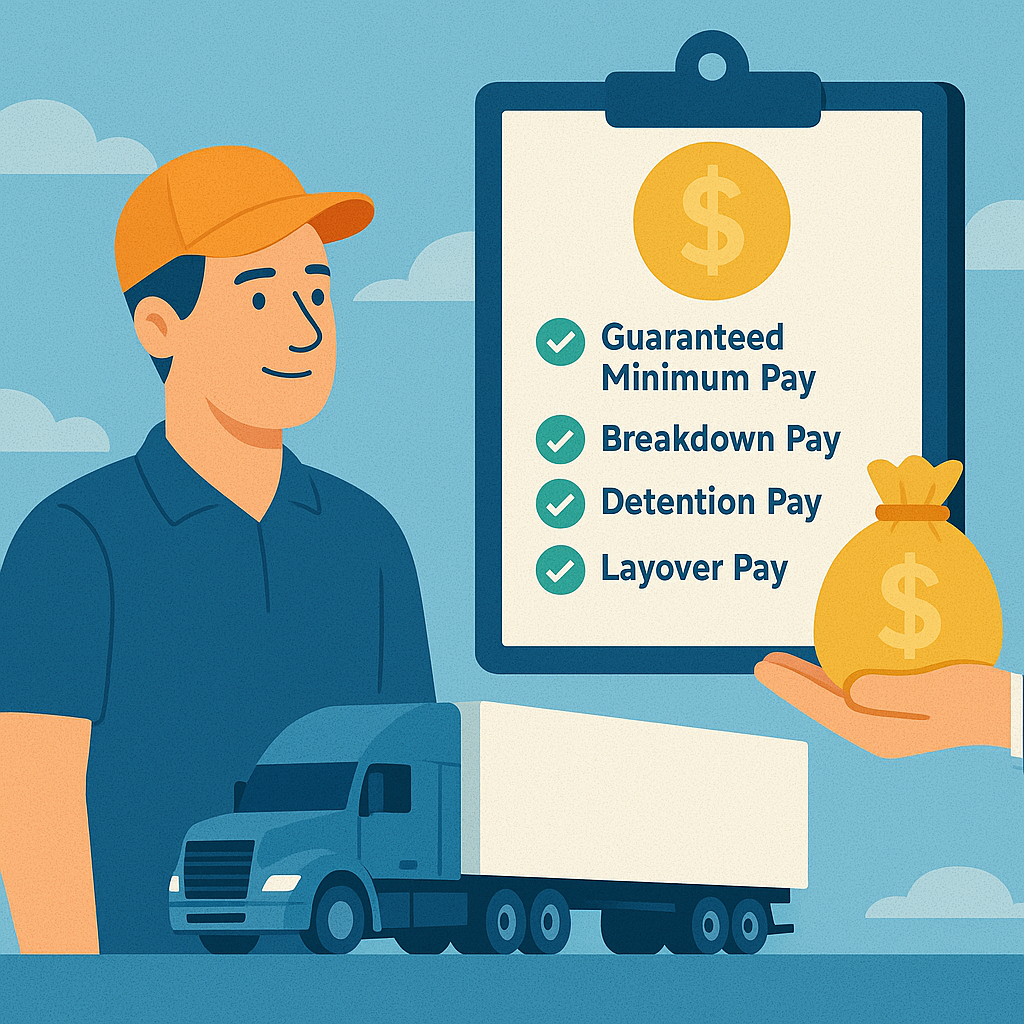
- Guaranteed minimum weekly pay bonuses
- Breakdown pay supplements
- Detention pay enhancements
- Layover compensation bonuses
Even compact income-guarantee structures create a massive retention effect. When drivers perceive the financial circumstances are stable, their loyalty will rise automatically.
F. Sign-On Bonuses: Effective or Not?
Even though sign-on bonuses have a lot of attention, they seldom help retention in the long run. Because they usually are effective in helping carriers to quickly fill openings and do not boost loyalty unless they are coupled with other programs. If the bonus is paid fairly—such as over a time period of 6–12 months it becomes more sustainable and aligns better with the strategies of retention.
The following factors show the sign-on bonuses which are efficient;
Visibility (without any hidden conditions)
Paid slowly, not upfront
Combined with performance or loyalty incentives
Otherwise, they just reward the act of joining, not the commitment to staying.
How to Build a Bonus System That Actually Improves Driver Retention
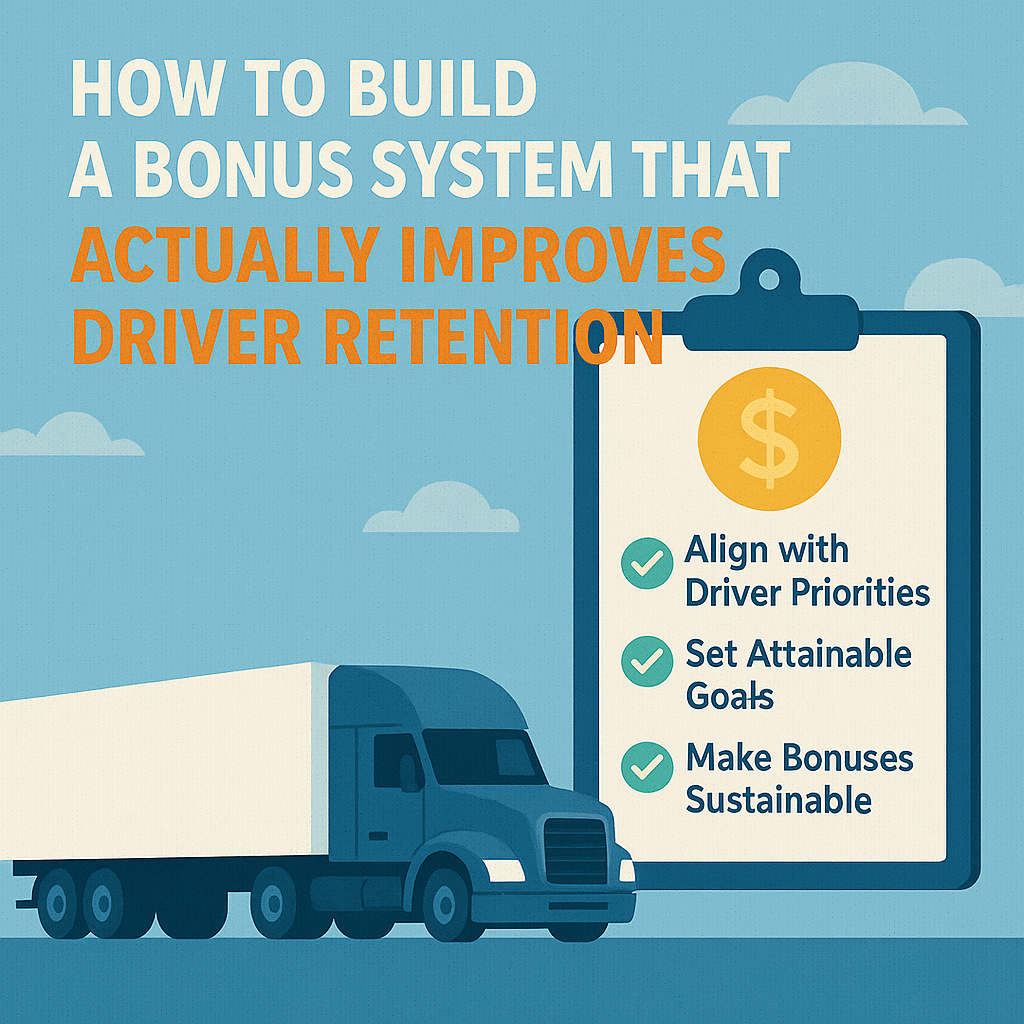
A bonus program must be built with intention. Many fleets put money into incentives without understanding what motivates drivers. Below are the core principles of building effective bonus systems that reduce turnover and increase loyalty.
Principle 1: Predictability Over Surprise
Drivers prefer predictable bonus systems over random rewards. Predictable incentives:
- Improve driver satisfaction
- Reduce frustration
- Allow drivers to calculate long-term income
- Strengthen trust between driver and carrier
A bonus that surprises a driver might create excitement, but it does little for retention.
Principle 2: Transparency Is Essential
Drivers should never guess how a bonus is earned.
A transparent system answers:
- What qualifies for the bonus?
- How is the amount calculated?
- When is it paid?
- What disqualifies a driver?
Secrets destroy retention; clarity strengthens it.
Principle 3: Bonuses Must Reflect Reality on the Road
If a bonus is impossible to achieve during winter, construction season, or freight slowdowns, drivers will view the program as manipulative. Effective driver incentives account for:
- Freight cycles
- Weather
- Delay risks
- Equipment differences
- Regional challenges
A practical bonus becomes a trusted part of driver compensation.
Principle 4: Bonuses” Align With Driver Psychology
Drivers stay where they feel respected, supported, and fairly rewarded.
Psychology-backed bonuses include:
- Recognition-based rewards (monthly recognitions)
- Stability-(minimum guarantees)
- Long-term value rewards (loyalty tiers)
Compensation is emotional as much as financial. Carriers who understand this outperform those who only offer cash.
Bonus Systems Drivers Consider the Most Fair
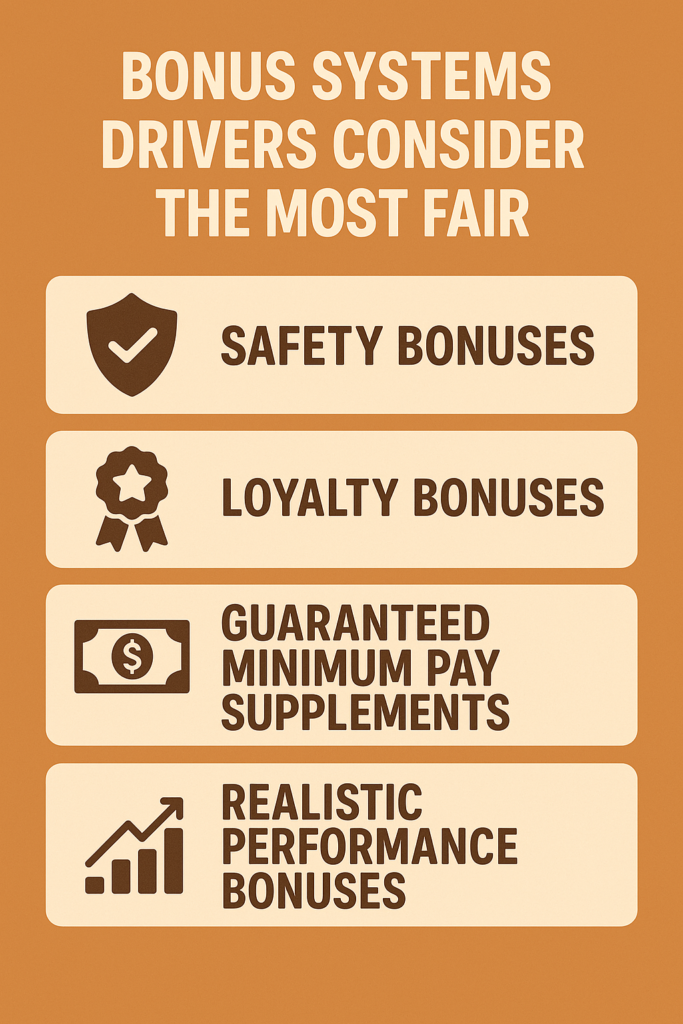
Interviews conducted across the industry consistently indicate that drivers deem the bonus systems outlined below as the most fair.
- Safety bonuses
- Loyalty bonuses
- Guaranteed minimum pay supplements
- Realistic performance bonuses
The incentives they measure are effort, predictability, and financial stability. They also support driver satisfaction without forcing drivers to chase miles against obligations.
Financial incentives
Bonus Systems That Help Reduce Driver Turnover
To decrease driver turnover, the bonuThese must deal with the lack of drivers leaving for specific reasons. The main reasons for turnover are:
- Unpredictable pay
- Lack of respect or recognition
- Feeling overworked without reward
- Poor communication
- Insufficient home time
Bonuses systems that address such issues separately improve retention rates measurably.
The following elements, planned for retention through bonuses, can have an effect:
- Quarterly loyalty payments
- Guaranteed weekly income floors
- Safety-based pay increases
- Flexible productivity tiers
- Clear, written retention programs
Drivers stay where the compensation structure is not just about high miles but also stability and growth.
What Makes a Bonus System Fail?
The transportation industry has seen every kind of incentive plan imaginable and some of them just don’t work. It is the standard features that those that fail have in common.
- They are not user-friendly
- Goals are unrealistic or unreachable
- Rewards are inconsistent
- Bonuses are delayed or denied without explanation
- Programs focus on the recruitment side and not the retention
- The incentives do not reflect the real-life scenarios of the drivers
If a driver can’t condense the bonus system into one sentence, it is overly complex for it to work.
Retention strategies
Designing a Retention-Focused Bonus Program: A Practical Blueprint
A successful bonus system for driver retention should include:
- A stable base bonus (safety or reliability)
Drivers value bonuses tied to consistency, not luck. - A loyalty structure with multi-tier rewards
Retention grows when drivers see increasing long-term value. - A realistic productivity component
Bonuses must reflect achievable goals. - Income-protection bonuses
Breakdown, layover, and detention compensation reduce turnover significantly. - Transparent documentation
Every driver should receive a clear explanation in writing.
Bonus systems are not about spending more — they are about spending correctly.
Conclusion: What Bonus Systems Truly Work for Driver Retention

Driver retention in the trucking industry is shaped by respect, clarity, and stability. Bonus systems become effective when they reflect real working conditions and reward real behaviors. Sign-on bonuses may bring drivers in, but performance bonuses, safety bonuses, loyalty bonuses, and income-stability incentives are what keep drivers from leaving.
The best bonus systems:
- Strengthen driver loyalty
- Reduce driver turnover
- Improve productivity
- Increase driver satisfaction
- Support long-term retention
In the transportation industry, compensation is not just money — it is communication. A bonus system tells a driver whether the carrier values short-term capacity or long-term partnership. The fleets that choose the delen to you, the viewer!
Final note on compensation and retention alignment
Last comment on aligning compensation with retention
Retention strategies practicing the real thing involve a combination of guaranteed driver pay, transparent carrier bonuses, and fidelities incentive programs presented to the drivers which are documented in details and easily comprehensible. The system of bonuses is regarded as an additional employee benefit and a financial strategic tool to replace the short-in time recruitment with true employee retention. In trucking, the bonuses that are truly effective are the ones that drivers can include in their financial planning, monitor for the period, and depend on as a constant part of their remuneration scheme. Retention strategies in trucking work best when successful bonus plans are treated as long-term employee benefits rather than short-term recruitment tools. Financial incentives that are clearly explained and consistently applied become effective bonuses only when they support employee retention instead of quick turnover cycles.
Leave a Reply