
Understanding Why Home Time Myths Appear in an OTR Career
Time at home and pay is equal, but the driver experiences to two are quite different on the road. Pay is calculated using formulas and freight rates, while home time follows what people expect, personal responsibilities, and the situation of freight movement. This is the reason home time myths that are surfacely created become the freight industry’s promotional surprises and ambiguous messages, especially when drivers are negotiating home time and do not realize the boundaries of what is possible. For many, these expectations also shape truck driving relationships and how they manage personal life on the road, especially during an OTR career where long-haul trucking often becomes part of everyday life.
How Misconceptions Form and Impact Drivers’ Personal Life
Most drivers join the industry with a lot of misconceptions, many of which they have gotten from friends, recruiters, and social media. These are often based on experiences that one driver may have gone through under specific circumstances and are not indicative of the driver experience as a whole. Encountering their fantasies with the strict scheduling system of trucking is likely to disillusion them except for the time the driver is conscious about the reasonableness of the request they are making. This is even more complicated by the regular prevalence of work schedule myths, presumptions about job expectations, and an overarching disregard for the true nature of the home time arrangements intertwining in a freight company. These beliefs also influence maintaining relationships OTR and the balancing work and personal life challenges that long-haul trucking brings to anyone living the over the road trucking lifestyle.
Why Home Time Is Misunderstood
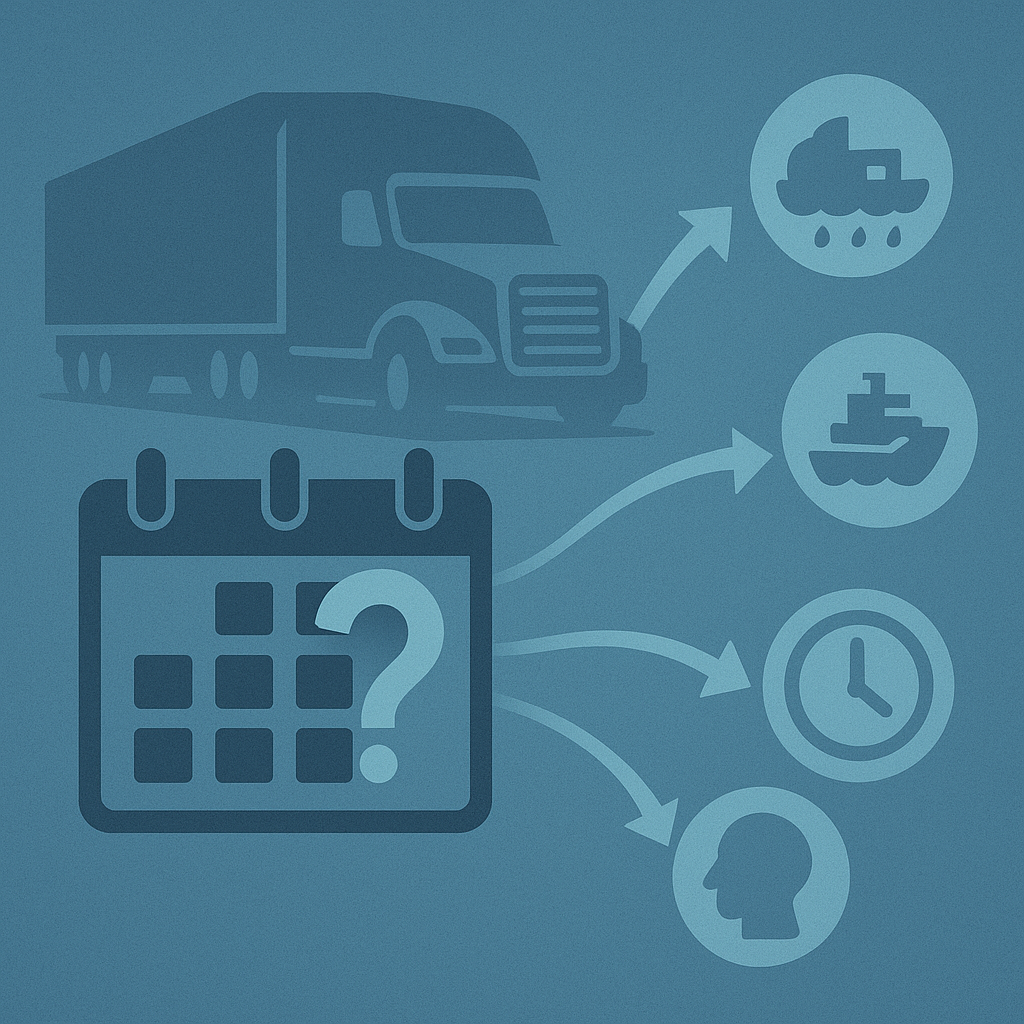
A mistake in understanding is based on the term and its context. As if the “ideal home time” were to be a kind of standard with predefined elements like an insurance plan or salary package clause. Nonetheless, truckloads are always assigned routes based on the factors of weather, drivers’ habits, shippers and receivers, and the time freight can be loaded in other areas. The home-time experience of a truck driver is the result of many such factors working together. So, this misunderstanding leads to the idea that home time is just a “yes/no” issue. It is no, and the belief that it is one of the classic scheduling myths. These expectations often spill over into truck driver family life and the pressure drivers feel to maintain communication strategies that meet everyone’s expectations, especially when managing personal life becomes harder on the road.
How Freight Cycles Change Home Time Outcomes
Because drivers regard home time as the standard, they usually consider it to be a rhythm — a sequence the company controls. Later, the young drivers will find that home time exists in a freight ecosystem, with or without particular drivers. When freight is abundant, the routes are dense, and the customer time frames are synced, there are no problems getting home. The exact same company, in some of the pedestrian season or low freight conditions, routing a driver home can be challenging due to lack of another customer. It’s not about the company as being good or bad, but about routing and how much the trucking company can flex its workplace. Many drivers also discover how these fluctuations affect a truck driver marriage or long-distance partnerships, shaping the trucker lifestyle far more than they expected and testing how well they are staying connected with people at home.
Why Two Drivers at the Same Company Have Different Home Time
| Factor | Driver A | Driver B |
| Distance from freight hub | Lives near major shipping junction | Lives in low-volume rural zone |
| Outbound load density | Many options | Limited options |
| Regional freight cycles | Stable | Unpredictable |
| Dispatch flexibility | High | Restricted |
The Myth of Uniform Home Time
Here comes the first myth, the belief in home time homogeny. A driver working with the same carrier can be one who always goes home on time or another who is always late. Generally the difference between both drivers is not in their performance but in the origin of their loads, the distance from home, or the outbound loads available in that region. Usually, drivers living near shipping hubs are more successful. On the other hand, drivers from areas with fewer shipping points have more difficulties. Understanding this helps shape realistic relationship tips for truckers who navigate unpredictable schedules and try to preserve their personal connections even in an OTR career.
The Myth of Unlimited Home Time
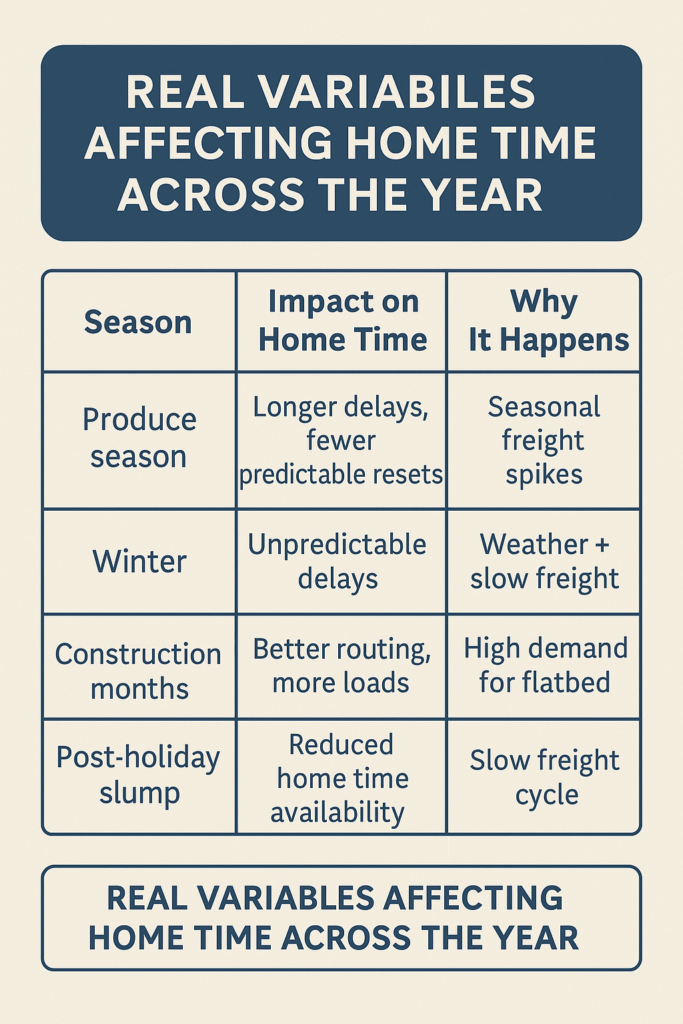
The second myth comes from the thinking that there are no limits to home time. Some drivers get it wrong when they hear “You are going to be home every weekend,” they believe that means the entire year. However, freight can vary monthly and that variation can be considerable. After a seasonal/festival break, some routes become less active. The produce season floods the reefer market, which is an imbalance. Flatbed related building seasons go high, then disappear. These situations directly affect driver’s home time, for instance a good plan in June may no more be available in October. This again is connected to scheduling myths and unrealistic expectations related to home time, showing how fragile work-life balance trucking can be when managing personal life depends on things no one can control.
Real Variables Affecting Home Time Across the Year
| Season | Impact on Home Time | Why It Happens |
| Produce season | Longer delays, fewer predictable resets | Seasonal freight spikes |
| Winter | Unpredictable delays | Weather + slow freight |
| Construction months | Better routing, more loads | High demand for flatbed |
| Post-holiday slump | Reduced home time availability | Slow freight cycle |
External Factors That Carriers Cannot Control
Some drivers believe home time is determined only by the carrier. What they do not understand is that dispatch can not just “send” them home. They also have to consider that a shipper may delay a load, a customer may be closed for a holiday, a warehouse may have an overloaded dock or a traffic closure may require to reroute. Most of the home-time issues arise because of reasons that are absolutely out of the company’s control. To a driver, it can be like no causes of action at all, seeing effects only. This uncertainty also pressures the truck driver routine and overall personal life management, especially in long-haul trucking where every delay affects someone waiting at home.
Performance Does Not Override Freight Reality
Likewise, drivers tend to believe that being a good worker would guarantee them “ideal time-offs.” There is connection, sure, between performance and better results, but no driver whatsoever can forgo rainstorms, freight shortages, or canceled customer orders. This clarification helps to stave off irritations and prevents faulty expectations involving flexible work or compressed working hours in these industries which are structurally incapable of functioning like an office job. It also sets more reasonable expectations for any road warrior life balancing personal commitments with OTR responsibilities.
Negotiation Power Drivers Actually Have
The flip side is the new myth that drivers have no power in negotiations. This is not true. What drivers cannot negotiate is freight traffic, but they can get things like — start dates, preferred resets, return trip frequency, key home-time days, and run regions all into their negotiations. These are sponsorship negotiations, not trick ones. Actually in a lot of cases, companies give more flexibility than they make it sound. A number of carriers have specific patterns, but they just won’t tell you unless the driver asks about it. Drivers who go ahead and ask the right questions usually uncover options that others never hear of. That’s where negotiation terms actually work.

Communication Determines 50% of Home Time Success
Clearly, how one communicates is also a huge element. If the dispatch gets something that is not clear such as “I need more home time” they can’t do much. Instead a clear sentence like “I need to be home every second weekend, ideally Friday night but Saturday morning is still acceptable,” will allow for better planning. Transparency is one of the most straightforward means of bargaining because it allows one to be effective without any conflict thus creating variations in schedules that can work within the constraints of trucking. Good communication strategies also improve how drivers manage truck driving relationships while staying connected with spouses, partners, and family.
Evidence from the sector also stands for this perspective: According to a comprehensive study carried out by CloudTrucks, “Regular communication routines, such as daily check-ins or planned weekly calls, have a significant positive effect on the relationship stability of OTR drivers and reduce the conflict associated with the unpredictable schedules.” https://www.cloudtrucks.com/blog-post/work-life-balance-as-a-truck-driver?utm_source
Examples of Clear Communication for Better Home Time
- “I need a 34-hour reset at home every second weekend.”
- “I can stay out 3 weeks straight if I have guaranteed home time on the 4th.”
- “Friday nights are preferred, but early Saturday arrivals still work.”
Why Home Time Carries Emotional Weight
The Truth of Trucking Life : Life on the Road
One more thing that is a reason for misunderstanding is the fact that trucking incorporates more than many industries blend work and personal life. Home time brings out birthdays, doctor appointments, relationships, sleep, child care, and mental recovery. A delay of a load will affect a single person’s life, not just a calendar. This emotional weight creates heavier disruptions and drives drivers to unrealistic beliefs about ideal home time, especially for any truck driver spouse who depends on predictable routines.
FAQ
1. What does “Understanding Freight Patterns to Reduce Stress” mean for drivers?
Understanding Freight Patterns to Reduce Stress
On the contrary, drivers often do not perceive the real structures at work such as: freight density maps, customer volume charts, seasonal projections, regional freight shortages, etc. With this misinformation, drivers often think that dispatch is acting against them when in truth it is the geography-induced limitation. They start seeing the patterns which lead to them being able to ask for changes earlier which causes the home time plan to be successful instead of chaotic.
2. Why can’t one home-time approach fit all drivers?
Why One Approach Cannot Fit All Drivers
There is another myth expressed too: driving directors should be treated the same. No, they should not be the same. Some people are more productive with different rhythms. For example: long breaks, weekends, weekdays, parent duties, or just seasonal needs. If you regard home time as uniform entitlement, you ignore the rights of the employee, home responsibilities, and the time it takes for the individual to adjust to the leave requests of each driver.
3. What is the difference between marketed and operational home time?
Marketed vs Operational Home Time Differences
Getting to know the difference between marketed home time and operational home time is very important for the drivers. While job ads just present a clearer picture, a line as simple as “home weekends” can mean different days even depending on the freight situation. Heeding such imbalances will enable drivers to be wiser in negotiations and thus avoid frustrations associated with work-schedule myths.
4. What parts of home time can be negotiated — and what cannot?
What Can Be Negotiated — And What Cannot
The ability to negotiate is based on having an understanding of which factors can be altered, which can be half altered, or which are not alterable. Drivers with unrealistic expectations think that they are being treated unfairly all the time. In the end, drivers who set out within their limits tend to have the most favorable results. The idea is similar to flexitime negotiations in other sectors but adjusted for the trucking realities.
5. What is the real structure behind sustainable home time?
The Reality of Building Sustainable Home Time
Simply speaking: home time is not a constant benefit; it is the delicate balance between the movement of freight and the needs of the person concerned, which is managed. With the right communication, both parties are able to manage the rhythm better by early, clear, and realistic communication.
6. Why do successful drivers understand the myths early?
The Drivers Who Succeed Understand the Myths Early
The best performers are those who learn the myth before adopting it. As misinformation drops negotiations turn into straightforward and cooperative transactions. The drivers do wield influence. But they do not do so over weather or freight cycles; they do so through communication, planning, and flexibility around working hours. With the proper expectations and proactive dialogue, they get home time patterns that are workable instead of chaotic.
7. What does a realistic, negotiated home-time arrangement look like?
A Realistic, Negotiated Home Time—Not a Mythical One
The idea of the “ideal home time” is not a mirage, it is exactly what a realistic home time is, it is negotiated, it is regular, and it is built only on mutual vision, not on myths, assumptions, or empty promises. Commonly, realizing work flexibility, addressing home time myths, and playing with remote work negotiation principles give drivers a sense of control over their work life that they didn’t think they had, even in an OTR career where balancing work and personal life is often the central challenge.
Leave a Reply