
A career in a trucking fleet often seems vague and random to most drivers. Most drivers assume that the only way to climb the organizational ladder is to leave the company, change to an office job, or hit the road for good. The fact is, fleets sport a hierarchical structure of clearly defined routines — jobs, responsibilities, KPIs, and career paths — most drivers will never see the whole one. This leads to the fact that some drivers really believe that the trucking industry has no career ladder at all. But it does. And it’s much more accessible than most drivers think, especially when drivers understand roles and responsibilities inside real fleet operations.
The transportation sector is the home of successful people who know the relationship between skills, performance measures, and profit in fleet operations. A rider’s career is not random, nor does it depend on the goodwill of management; it is based on role knowledge, KPI recognition, and skill improvement. When drivers read the hierarchy chart, they have it revealed to them how a fleet’s career advancement really works and the path they must take from one step to the next within a serious logistics career structure.
The Relevance of This Topic in Trucking
For the majority of new drivers, the trucking career wheel seems to be absolutely horizontal: company driver → more miles → higher pay. It can be summed up in these terms. Nevertheless, the structure is what fleets are made of: dispatch, safety, training, fleet management, operations, logistics coordination, and succession planning. Each of the above-shown fleet roles counts its unique performance metrics and building opportunities. The drivers who see the structure clearly, progress faster. The drivers who don’t—usually, they do not advance for years.
Misinterpretation of the career ladder results in feelings of estrangement, low employee retention, and needless turnover. Knowledge of fleet hierarchy, important performance indicators, and the needed driver skills provides the key to success in the career inside the transport industry.
Fleet Hierarchy: Roles, Responsibilities, Skills, KPIs
| Fleet Role | Responsibilities | Required Skills | Typical KPIs |
| Driver | Deliver freight safely, maintain logs | Driving skills, time management | On-time %, safety score, fuel efficiency |
| Driver Mentor / Trainer | Train rookies, support skill development | Communication, leadership | Rookie retention, training completion |
| Dispatcher | Plan routes, manage loads | Routing, coordination | Load efficiency, service levels |
| Safety Coordinator | Compliance, incident prevention | FMCSA knowledge, coaching | Incident rate reduction |
| Fleet Manager | Manage drivers, performance, operations | Leadership, analytics, talent management | Fleet productivity, utilization, turnover |
How Fleet Management Sees Career Development
Fleet management does not view roles in the isolated manner of job titles but in the broad view of systems through interconnected responsibilities. For instance, a driver may focus on miles and routes, while a fleet manager looks at performance metrics: safety, on-time delivery, communication quality, and readiness for additional responsibilities. These expectations are also reflected in compensation structure decisions and advancement opportunities.
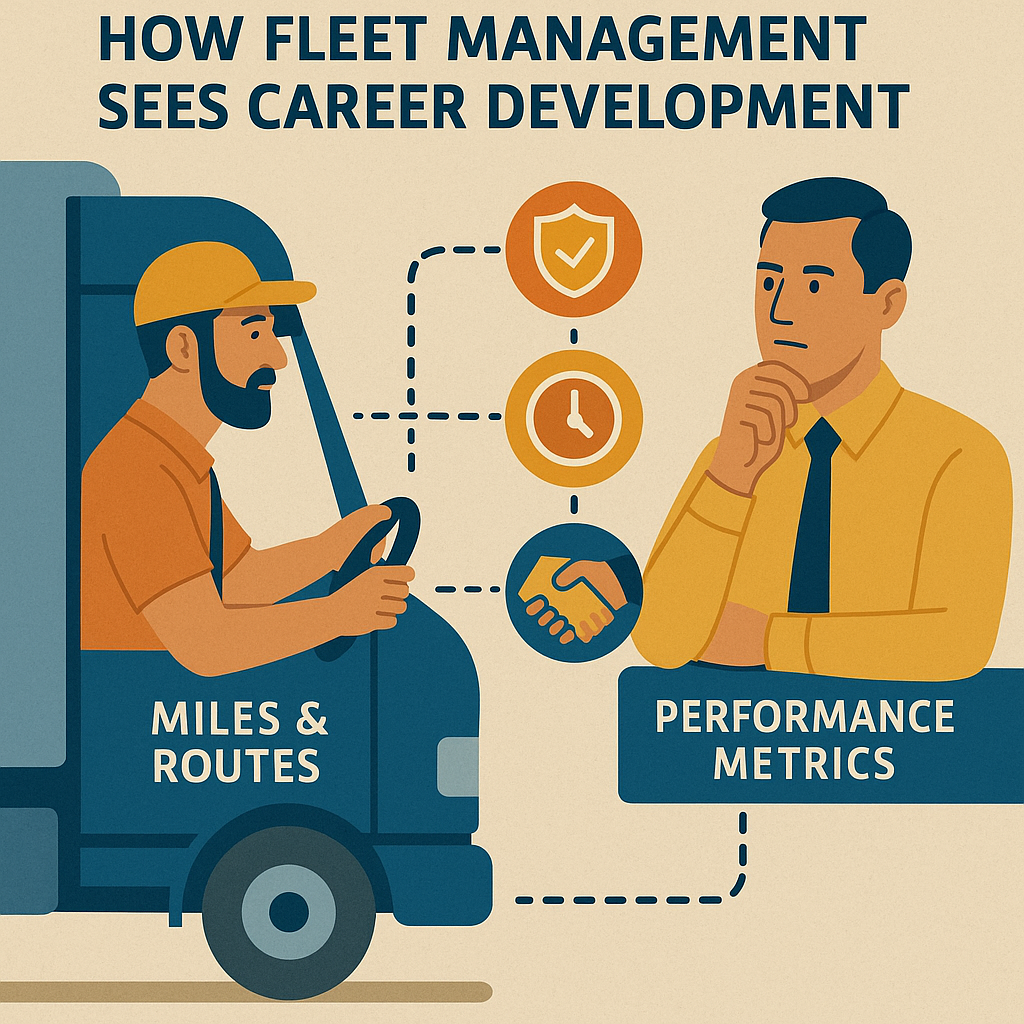
Career moving happens inside a fleet as a well-orchestrated process. Promotions are driven by measurable KPIs, behavioral patterns in the workplace, dependability, and the potential for leadership. When drivers start to think in KPIs and performance metrics terms, they begin to realize that they can trigger opportunity for advancement in any transportation industry fleet.
Job description of Fleet Manager – Role, Responsibilities & Skills
What Drivers Think vs. What Really Moves Them Up
The majority of the drivers when they start their careers are convinced that they are going to get a promotion only through their perfect driving skills. They anticipate:
“If I drive hard, I will be promoted.”
“I am seasoned by the years.”
“The management recognizes my efforts automatically.”
However, the reality of fleet operations is different:
Steps like driving, communication, and decision-making are what promotions are made of and serve. Skills are what the foundation is built on.
When experience is backed by numbers it will be helpful, and when the experience is not backed by numbers, it is of no consequence.
Visibility of KPIs determines promotion far more than words of praise.
The pathway to success should be built on performance measures and not on assumptions. This is the core of professional development inside the fleet environment.
Fleet Career Ladder Myths
“Promotion just means higher pay.”
In trucking, promotion equals more power, more duty, and more effect – it is compensation that follows the structure, not vice versa.
“Skills just grow automatically.”
The years behind the wheel of a vehicle do not teach coaching, planning, documentation, or communication. They are the skills that need nurturing through time.
“Fleet hierarchy is fixed and hard to enter.”
In fact, fleets always crave trainers, dispatch helpers, safety coordinators, and drivers with leadership qualities. Opportunities arise far more frequently than drivers would observe in a typical truck driver career path.
Where the Real Career Progression Occurs
The real progress in a fleet is made when the driver makes the leap from only being the executor of the task to fully being operational. The typical career path through this transit is:
Driver → Driver Mentor → Lead Driver → Dispatcher → Safety → Fleet Manager → Operations Leadership
Every stage adds a new level of control, insight, and participation. The driver climbing the ladder of learning KPIs, communication, fleet operations the fastest is the one who understands skill development as a long-term investment. Job Preview: Trucking Fleet Manager @RoehlTransportInc
KPI Breakdown by Role
| Role | KPI Examples | Measurement Method |
| Driver | On-time %, CSA score, fuel use | ELD data, logs, safety reports |
| Driver Trainer | Rookie retention, skill progression | 30/60/90-day performance tracking |
| Dispatcher | Load efficiency, route accuracy | Planned miles vs delivered miles |
| Safety Coordinator | Incident reduction | Monthly audits, coaching outcomes |
| Fleet Manager | Utilization, turnover, productivity | Fleet-wide analytics |
Where Drivers Shine in Career Development
A fleet career indeed can be climbed conveniently if a driver:
- is aware of their KPIs
- follows robust communication pattern
- grows the soft skills including skills beyond driving
- acquires extra loads of work by volunteering
- completes training programs for drivers and embraces driver training fully
- is consistent and reliable
The career path is set by steady performance rather than unpredictable talent.
Places Where Career Growth Ceases
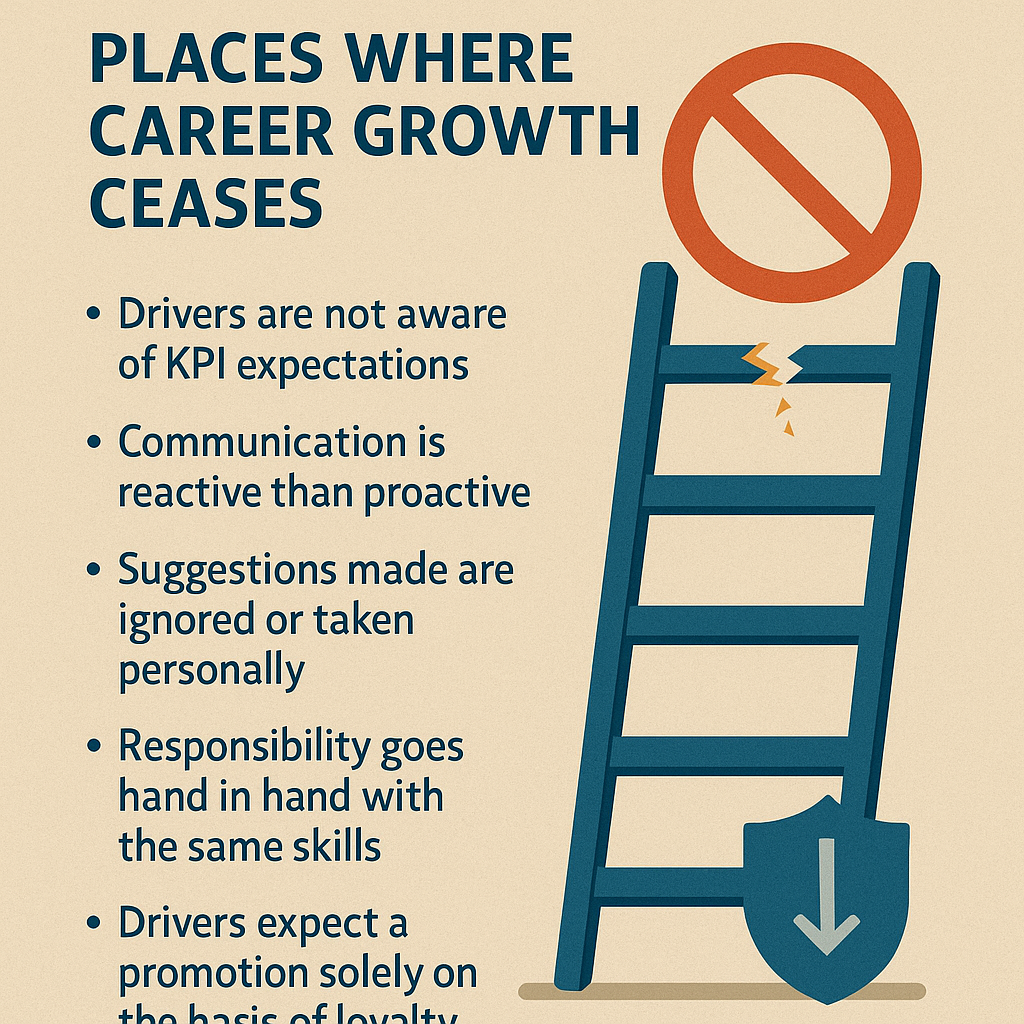
Career growth is at a standstill when:
Drivers are not aware of the KPI expectations.
Communication is reactive than proactive.
The suggestions made are ignored or taken personally.
The responsibility goes hand in hand with the same skills.
Drivers expect a promotion solely on the basis of loyalty.
Career ladders are cut when not all skills are aligned with responsibilities in the fleet hierarchy.
Where Fleet Managers Go Wrong
Even the best fleets can fail when:
- promotions are awarded without suitable training
- expectations are laid bare or not set
- KPI dashboards are not disseminated
- career paths are not altogether expressed
- informal succession planning is not discussed
A fleet is a healthy eco-life in which communication about the opportunities and their requirements is crystal clear.
What Drivers Get Wrong About Career Growth in Trucking
The widely held beliefs among drivers include:
“Hard work pays off with a promotion.”
“More miles yield more respect.”
“Office roles require a degree.”
“Fleet managers don’t want drivers to grow.”
But the full truth is that:
Fleets promote drivers who contribute to the operation’s smooth running and raised predictability, safety, and efficiency within logistics career systems.
How to Assess Your Career Potential in a Fleet
Go back to your KPIs.
Mainly safety, on-time performance, communication, and professionalism.
Identify the lacking skills.Most evidently, leadership, coaching, planning, administration, and analytics.
Opt for your next rational move. A position where your existing strengths and the required skills overlap is the best fit for real advancement opportunities.Career progression is a clearly measurable process that does not involve guesswork.
Instructor Info

Most drivers think that promotion is achieved through performing more of the duties. However, those who have led the fleet think otherwise. In the transport industry, you move up not by the number of your achievements but by the amount of duties you can fulfill without sacrificing your performance. The transition from the “task doer” to the “responsibility holder” is what makes the difference between the drivers who just accrue miles and those who consistently get promoted in the fleet’s hierarchy. Instructors insist that career development is directly related to key performance indicators, as these are the only measurable parameters that show a driver’s preparedness for a new responsibility. Experience proves the pattern: the drivers who achieve their KPIs without exception are the ones who go to the next step in their career easily and many impacted their environment positively. This is how instructors commonly express the readiness for the upcoming step.
Final Insights: The Real Home of the Career Ladder Is Here
A driving job provides the structure. A managerial job is about the influence.
A fleet position is the stable ground. A management job is about the strategy.
Driving instills discipline; leadership channels direction.
The true career ladder is built where skill development overrides opportunity and where KPI examples clearly show the difference between potential and readiness.
FAQ
1. Do KPIs actually decide promotion inside the fleet?
Absolutely. KPIs are the basically most objective and clear way for the management to evaluate the readiness for the higher level.
2. What are the most important skills besides driving?
Communication, decision-making, coaching skills, route management, and reliability.
3. Is a driver really able to become a fleet manager?
Definitely. The majority of fleet managers begin as drivers and grow through the development and acquirement of skills.
4.What is the typical time for career progression?
Drivers would generally observe the promotional offerings within 6–18 months thus if they lessen their KPIs and proactively build up their skills.
5. What is the role for the new driver to target the most?
Driver mentor or trainer—these are the first leadership-based steps in a fleet career scheme.
Leave a Reply