
When the beginner driver receives the first offer to drive a truck, the page usually appears much less than expected — but there is actually more to it than most newbies think. Typically, a carrier’s offer sheet comes with numbers on the CPM, a few concise pledges, and some perks that are pointed out. However, what is most important for an offer to a trucking driver is not what is mentioned in the highlights but the things in the fine print: the formula for calculating CPM (this is where cpm explained matters most), the actual definition of “minimum guarantees”, the principles of detention pay, and, in layover terms, the conditions for which it is triggered.
Learning about these trucking industry terms at the beginning will prevent any confusion that may arise later. A driver who is aware of how truck drivers read offers will immediately spot the difference between a fair company and one that hides weak freight behind attractive numbers. In this write-up, all the necessary information regarding CPM explained, driver pay guarantees, per-mile rate structures, layover rules, detention time, and every other small detail that matters for your real trucker salary is included. Many beginners simply look at CPM pay, but reading a truck offer fully is what protects long-term income.
The Importance of Reading a Trucking Offer Correctly
A trucking offer is more than a piece of paper; it’s a glimpse of the future:
- your income level’s stability
- the carrier’s procedure for handling downtime
- an indicator of the worth a driver is given
- the level of transparency in the compensation structure

There are many new drivers who will only check the sign-on bonus or CPM pay. The driver with more experience will focus on different aspects: detention and layover policies, guaranteed minimum pay, freight offer details, and other truck driver terms that determine whether the weekly check is stable or unpredictable.
A carrier offer contract that has no unanswered questions is a sign of strength.
CPM Explained: What Per-Mile Rate Really Means
CPM (cents per mile) may be the simple part of an offer, yet it is the one most propitious for misunderstandings. That is why understanding per mile rate logic early is crucial for every new driver.
Types of CPM You Might See
- Base CPM — The standard per-mile rate for all dispatched miles
- Sliding Scale CPM — Higher pay for shorter trips, lower for long-hauls
- Practical Miles CPM — Based on real routing
- Household Goods Miles (HHG) — Often shorter and pays less time
Questions Drivers Should Ask
- Are empty miles paid?
- Are bonuses included in the advertised CPM?
- Is performance CPM temporary or permanent?
- Is this CPM for solo, team, or specialized freight?
- Does the company mix CPM pay with pay per load in certain lanes?
A trucking offer that advertises high CPM but low miles is really a weaker bet as compared to the case when CPM is modest but freight is consistent.
CPM Comparison Types
| CPM Type | Description | What to Look Out For |
| Base CPM | Standard per-mile pay | Is this number final or “up to” CPM? |
| Practical Miles CPM | Paid based on real road miles | More accurate but depends on routing |
| HHG Miles | Shortest distance between cities | Usually 8–12% fewer paid miles |
| Sliding Scale CPM | Rate changes by trip length | Good for regional, weaker for OTR |
Guarantees: What “Minimum Pay” Actually Covers
The driver pay guarantees sound comforting, but they do not usually cover everything.
A typical guaranteed minimum pay clause usually means that if you have a bad week with freight or dispatch problems, the carrier will increase your pay to a certain level but only if you fulfill the conditions.
Common Guarantee Conditions
- A specific number of available days is required
- Refusal of assigned loads is not permitted
- Must finish all dispatched miles
- Must adhere to HOS or company policy
A driver pay guarantee will be of any worth only when the qualifications are straightforward.
Detention Pay Rules: When the Clock Is on Your Side
Detention problems are frequently very difficult to understand in any carrier offer sheet. Many rookies do not realize that detention pay rules vary dramatically between companies.
Detention pay is the amount a driver receives for not being loaded/unloaded when a shipper/receiver takes the truck longer than expected.
What Drivers Should Know
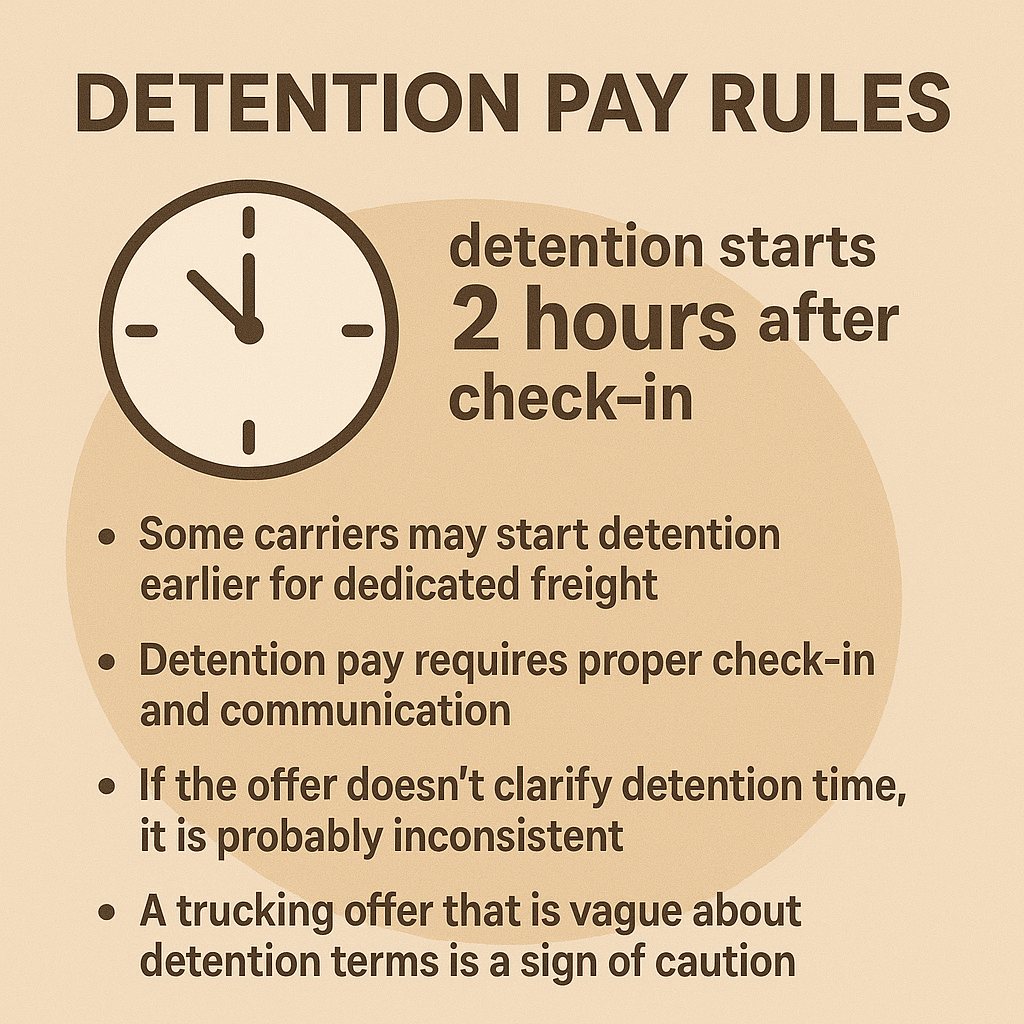
- Ordinarily, detention starts 2 hours after check-in, not right away
- Some carriers may start detention earlier for dedicated freight
- Detention pay requires proper check-in and communication
- If the offer doesn’t clarify detention time, it is probably inconsistent
A trucking offer that is vague about detention terms is a sign of caution.
The FMCSA has done a very interesting research that actually states that 10 percent of the roadside checks usually result in the trucks being detained for an average duration of 1.4 hours, thereby, causing driver’s pay to be directly affected because of the time they spend in detention that is not paid for. https://www.fmcsa.dot.gov/research-and-analysis/impact-driver-detention-time-safety-and-operations?utm_source=
Layover Compensation: When You’re Stuck Waiting Between Loads
A layover occurs when no freight is available and the driver is forced to sit idle for a longer time — usually overnight or 24 hours. Layover rules directly affect truck driver salary during slow seasons.
Typical Layover Rules
- Pay starts after 24 hours of no loads
- Rates typically range from $50 to $150 per 24 hours
- Requires being “available for dispatch”
- Not paid if delay is due to driver error
Many companies announce layover availability, yet the rate or conditions are only partly explained. Always ask for specifics.
Detention & Layover Breakdown
| Pay Type | Typical Trigger | Typical Rate | Key Detail |
| Detention Pay | 2+ hours at shipper/receiver | $15–$30/hr | Requires check-in timestamp |
| Layover Pay | 24 hrs with no load | $50–$150/day | Must be available for dispatch |
| Breakdown Pay | Mechanical delay | Fixed daily rate | Only applies if fault isn’t driver’s |
| Weather Delay Pay | Severe conditions | Company-dependent | Often absent in weak offers |
Freight Offer Details That Influence Real Income
Two companies with the same CPM but different incomes can be influenced by:
- trip length
- freight lanes
- load types
- percentage of drop-and-hook
- operational region
A CDL new driver should study the route structure rather than judging only by rate-per-mile.
Important Route Indicators
- Does the carrier rely on congested regions?
- Are there long empty stretches?
- Is freight steady year-round?
A strong trucking offer clearly explains freight type, lane expectations, and seasonal patterns.
How Experienced Drivers Read an Offer Contract
An experienced trucker skims CPM first — but then immediately checks the parts that control earnings:
- When detention begins
- How breakdown pay works
- Whether layover pay is capped
- How miles are calculated
- Whether guarantees are weekly or monthly
- Bonus payout timing
- Whether a lane includes CPM pay or pay per load
The secret value of an offer is rarely in the headline CPM; it is in the small print.
A Simple Framework for Reading Any Trucking Offer
A long-lasting checklist for any driver:
Offer Evaluation Checklist
- Does CPM include temporary bonuses?
- Are empty miles paid?
- What is the average weekly miles?
- Is guaranteed minimum pay available?
- When does detention begin?
- How is layover calculated?
- What are dispatch expectations?
- Are route types predictable?
- Is breakdown pay included?
If a carrier avoids answering these questions, that is instability.
Final Thoughts: Understanding Your Offer Protects Your Pay

A trucking offer is not purely a CPM. It is mainly about how you will be recompensed for your time and miles. Only upon drivers knowing CPM thoroughly from the perspective of a proper explanation, reading all pages of the contract, understanding detention time, layover rules, per-mile rate definitions, and the whole compensation scheme can they avoid the common traps which are faced by the majority of new drivers. The better a carrier is at being transparent, the more likely they will treat you that way on the road.
Just numbers are not sufficient for a well-prepared offer to mirror the company’s fairness and professionalism. If the conditions are straightforward, then the needs are achievable, and the wages are uniform, a driver will be able to project the gains without any guesswork. When the terms are complex or filled with conditions, that generally means unsteady weeks and frustration that is left for later.
Clear-carrying is the flag of a quality carrier.
Detail-burying is a symbol of a weak carrier.
Only a well-informed driver can understand a truck offer, compare it to real driving conditions, and make a selection of a carrier that is honest as much as it is productive. Such-awareness is not only helpful during the first year but throughout the whole trucking career.
Common Questions New Drivers Ask When Reading a Trucking Offer FAQ
1. Why is CPM pay not enough to judge an offer?
Absolutely! The figure of CPM pay is but a very small fragment of a trucking offer. Each two companies could post the same rate yet the real income would be influenced by the variables like miles per week, freight consistency, unpaid delays, and how miles are calculated. Therefore, it is advisable for drivers to always check CPM against the average ones, instead of just going with the advertised figure.
2. When does the layover compensation usually starts?
24-hour layover compensation is the usual doorkeeper for no load, but, each carrier implements different calculations, Some ask for you to remain fully obtainable for dispatch when other ones cut pay based on location or load type. Every offer does not directly indicate the layover compensation figure as layovers before signing be checked.
3. Why is it so vital for the offer sheet to have detention pay rules?
Detention is one of the main concealed income sources. If the detention payment is made too late, too irregular or only accepted conditionally, a driver would lose working hours, not even mentioning the lack of earnings. The strong offers mention when detention begins, the rate per hour, and what is to be documented.
Leave a Reply